Rembrandt van Rijn
A PRIVATE OFFERING BY THE AMERICAN ROTHSCHILD COLLECTION
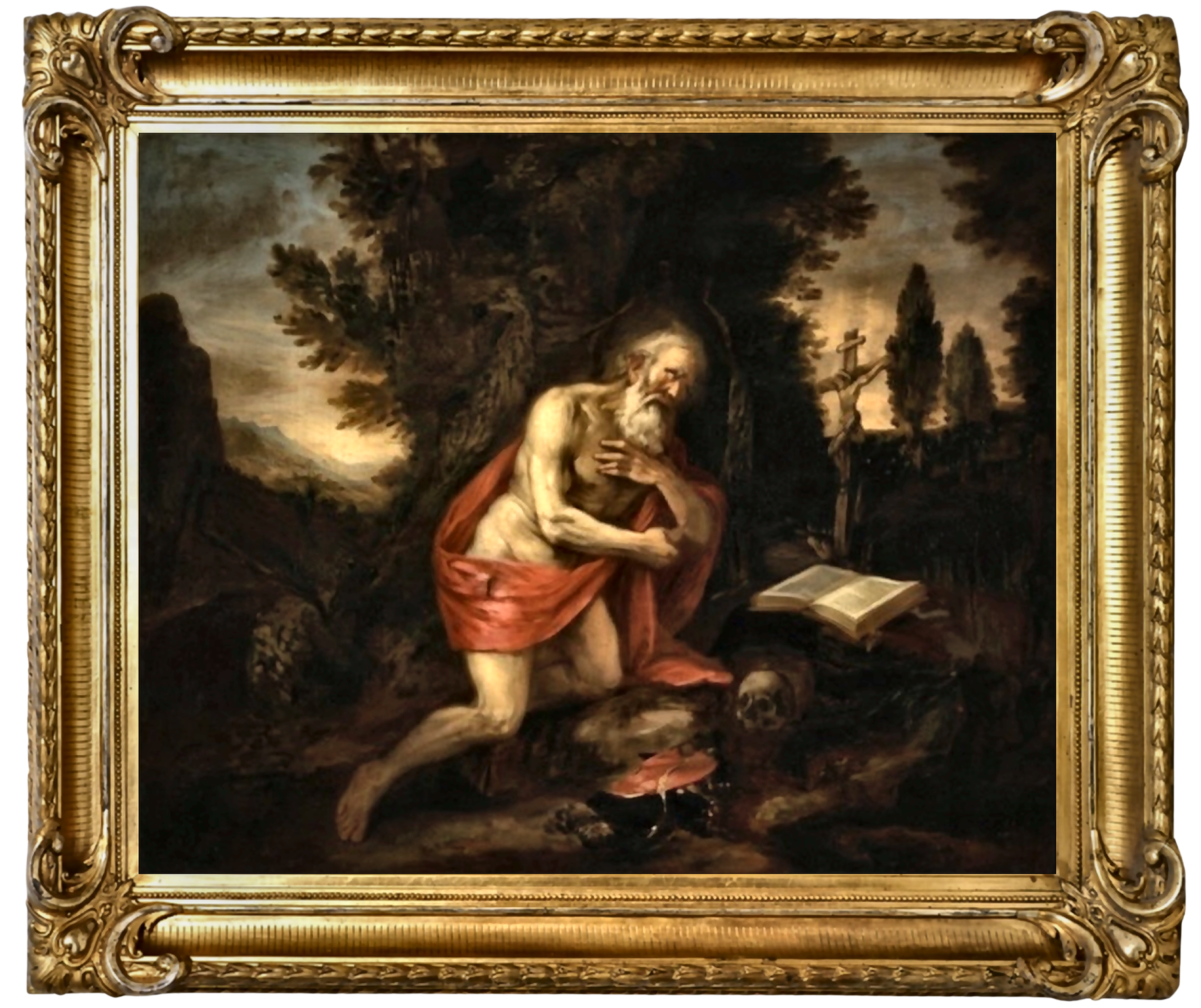
Rembrandt van Rijn, Saint Jerome in the Wilderness (c. 1652-1655)
Oil on canvas • 135.3 x 106.7 cm.
The Final Wilderness
A TREATISE IN TWO PARTS
—
Rembrandt and the Two-Century Pursuit of Saint Jerome
Preface
No subject in the history of Western religious painting generated a more sustained, more obsessive, or more revelatory sequence of masterworks than the solitary figure of Saint Jerome in the wilderness. From the claustrophobic intimacy of van Eyck’s Flemish study, through the Venetian atmospheric grandeur of Titian and the searing Caravaggist darkness of the early seventeenth century, the subject accumulated two centuries of visual intelligence before arriving, in the 1650s, at the studio of Rembrandt Harmensz. van Rijn in Amsterdam.
This treatise argues a single thesis: that Rembrandt’s Saint Jerome in the Wilderness, now in the collection of The
American Rothschild Collection, LLC, represents not merely another distinguished entry in the iconographic tradition but its conscious, deliberate, and unrepeatable culmination. No subsequent treatment of the subject approached the psychological and painterly intensity Rembrandt concentrated into this canvas. He had absorbed the entire tradition — from van Eyck’s microscopic detail to Titian’s atmospheric grandeur — and in the 1650s he distilled it into something wholly his own and wholly final.
Part One surveys eleven masterworks of the tradition in chronological order, tracking the evolution of the saint’s iconography, the shifting balance between landscape and figure, between scholarly meditation and penitential anguish. Part Two turns to the Rembrandt itself: the argument for his supremacy, the conditions of the Dutch Golden Age that made his achievement possible, and a full technical and scholarly catalogue of the ARC Collection work.
The American Rothschild Collection, LLC offers this treatise as both a contribution to Rembrandt scholarship and a demonstration of its fundamental conviction: that the great works of art history are not passive objects of contemplation but active arguments about the nature of human experience

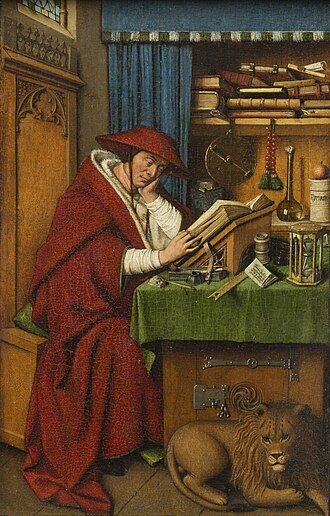
No. II
Saint Jerome in His Study
Antonello da Messina
Date
c. 1474–1475
Medium
Oil on limewood panel
Dimensions
45.7 × 36.2 cm (18 × 14.3 in)
Location
National Gallery, London
Analysis
Antonello fuses Flemish precision with Italian spatial command, placing the saint within a vast Gothic interior glimpsed through a stone arch. The tiled floor recedes with rigorous perspective; a peacock and partridge observe from the foreground. Jerome is absorbed entirely in his reading. This is a masterwork of cultural synthesis — the Flemish love of accumulated detail married to the Italian command of unified space.
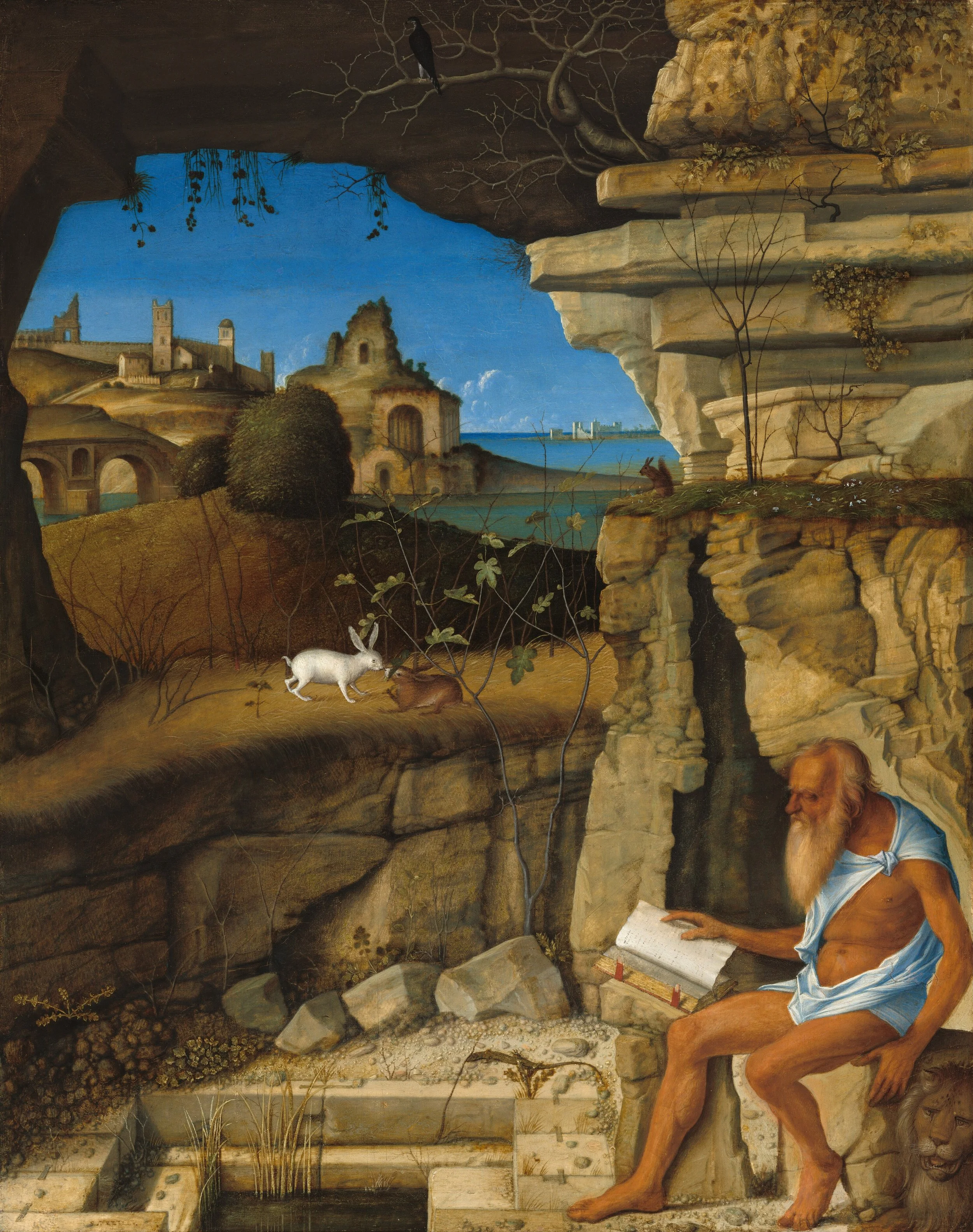
No. I
Saint Jerome in His Study
Jan van Eyck
Date
c. 1435–1437
Medium
Oil on linden panel
Dimensions
20.1 × 13.1 cm (7.9 × 5.2 in)
Location
Detroit Institute of Arts, Detroit
Analysis
Van Eyck opens the tradition with microscopic Flemish precision. Jerome occupies a scholar’s study dense with books, instruments and devotional objects, the lion dozing beneath his desk. Every surface catches light with the breathtaking exactitude of oil paint in its infancy. This is Jerome as scholar-saint, at home in civilization. The wilderness is entirely absent — it will take another century and a half to arrive.
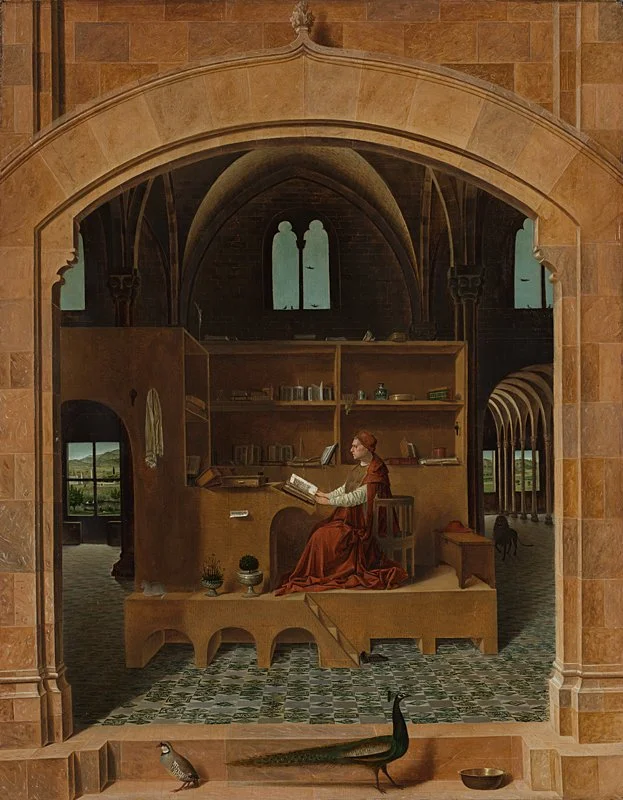
No. III
Saint Jerome Reading in a Landscape
Giovanni Bellini
Date
c. 1480–1490
Medium
Oil on panel
Dimensions
47 × 34 cm (18.5 × 13.4 in)
Location
National Gallery of Art, Washington D.C.
Analysis
With Bellini, the tradition makes its decisive shift from interior to wilderness. Jerome sits in the open air, a landscape of lyrical beauty stretching behind him: cliffs, a bridge, a distant city, rabbits running on the path. The figure is small within the landscape. Bellini’s warm luminous colour gives the wilderness an almost paradisal quality — the saint has not so much fled civilization as found a better one.
No. II
Saint Jerome in His Study
Antonello da Messina
Date
c. 1474–1475
Medium
Oil on limewood panel
Dimensions
45.7 × 36.2 cm (18 × 14.3 in)
Location
National Gallery, London
Analysis
Antonello fuses Flemish precision with Italian spatial command, placing the saint within a vast Gothic interior glimpsed through a stone arch. The tiled floor recedes with rigorous perspective; a peacock and partridge observe from the foreground. Jerome is absorbed entirely in his reading. This is a masterwork of cultural synthesis — the Flemish love of accumulated detail married to the Italian command of unified space.
No. I
Saint Jerome in His Study
Jan van Eyck
Date
c. 1435–1437
Medium
Oil on linden panel
Dimensions
20.1 × 13.1 cm (7.9 × 5.2 in)
Location
Detroit Institute of Arts, Detroit
Analysis
Van Eyck opens the tradition with microscopic Flemish precision. Jerome occupies a scholar’s study dense with books, instruments and devotional objects, the lion dozing beneath his desk. Every surface catches light with the breathtaking exactitude of oil paint in its infancy. This is Jerome as scholar-saint, at home in civilization. The wilderness is entirely absent — it will take another century and a half to arrive.
No. III
Saint Jerome Reading in a Landscape
Giovanni Bellini
Date
c. 1480–1490
Medium
Oil on panel
Dimensions
47 × 34 cm (18.5 × 13.4 in)
Location
National Gallery of Art, Washington D.C.
Analysis
With Bellini, the tradition makes its decisive shift from interior to wilderness. Jerome sits in the open air, a landscape of lyrical beauty stretching behind him: cliffs, a bridge, a distant city, rabbits running on the path. The figure is small within the landscape. Bellini’s warm luminous colour gives the wilderness an almost paradisal quality — the saint has not so much fled civilization as found a better one.